Hubbard
Where to find it
Sign in and open Challenges from the main navigation. Rival Week is the first panel. Below its Open Rival Week button is the heading Around the league, with the line Everyone's confirmed Rival Weeks, including yours.
Two buttons pick the week: This week and Next week. Cards load four at a time, and Show more Rival Weeks fetches the next four. Refresh league challenges reloads the list if you have kept the page open while other people play.
- Only accepted matches appear. An invitation that is still waiting for an answer, or one that was declined, is never shown to anyone else.
- Each card shows the two players' display names and animals, the agreed games and who won each one. It does not show anyone's times, guess counts or attempts.
- Your own card says You in place of your name and has an Open your match button that takes you to your full Rival Week page.
The big numbers are settled day wins
The top line of a card gives the date the match starts playing, then either Lined up, for a match that has not started, or Settled day wins. The large number under each player is that count. It only includes days that are finished, so today's result is not in it yet.
Remember how a day is won. Each of the eight agreed games gives one game win to the better result, or half each for a tie. Whoever has more game wins takes the day, and a level day gives half a day win to each player. That is why a card can read 1½ to 1½ after three days: one day each and one shared.
The Next week tab shows matches that are already agreed for the following Monday. Those cards read Lined up, 0 to 0, with every game marked To play, because nothing can have happened yet.
The Today line counts before both players have played
While a match is running, a smaller line under the big numbers reads something like Today: 3 to 2 game wins · Provisional. This is today's running game count, and it follows exactly the rule the day will be judged on: a player who has finished a game their opponent has not touched is already credited with that game win.
That is correct at midnight, when an unfinished game really is lost, but in the middle of the day it flatters whoever plays first. The labels on the games are more cautious. On a provisional day a game only shows Won or ½ each once both players have finished it or given up. Until then it shows Waiting, even though the Today line has already given the win to the player who finished. The labels always describe today, not the whole week.
Today changes from Provisional to Settled at midnight in London, or earlier if both players have finished or given up on all eight games. As soon as it settles, the day win moves into the big numbers.
- Won: the game has a winner, marked by the dot of the same colour as that player's name. On a provisional day this only appears once both players have finished or given up.
- ½ each: both finished with the same place in that day's field.
- Waiting: the day is still provisional and at least one player has not finished the game.
- Unplayed: the day settled and neither player completed the game, so nobody gets it.
- To play: the match has not reached a playing day yet.
One Thursday, worked through
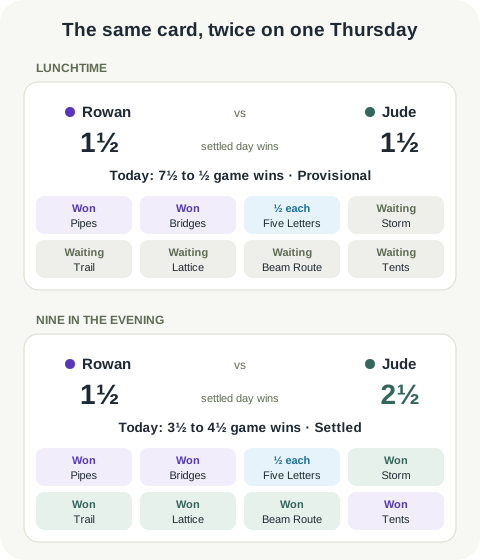
Take two players, Rowan and Jude, who agreed Pipes, Bridges, Storm, Trail, Five Letters, Lattice, Beam Route and Tents for the week. Rowan won Monday, Jude won Tuesday and Wednesday was level at 4 game wins each, so both go into Thursday on 1½ day wins.
Rowan plays all eight on the way to work. Jude manages three before lunch. Of those three, Rowan was quicker at Pipes and Bridges, and they both took four guesses at Five Letters and share the same place in the day's field. At lunchtime the card reads Today: 7½ to ½. That is 2 for Pipes and Bridges, ½ for the shared Five Letters, and 5 for the games Jude has not played yet. Five of the eight labels say Waiting.
Jude plays the other five that evening and beats Rowan's result on Storm, Trail, Lattice and Beam Route, while Rowan's Tents time holds up. Now Rowan has 2 + ½ + 1 = 3½ and Jude has ½ + 4 = 4½. All eight games are finished by both players, so the day settles at nine o'clock without waiting for midnight, and the big numbers move to Rowan 1½, Jude 2½.
If Jude had not come back at all, the lunchtime figure would have stood: at midnight the five unplayed games go to Rowan, 7½ to ½, and Rowan takes the day. The Today line was never wrong, it was just early.
The mistake to avoid
Do not read a big Today lead as a rout, and do not rush your own games because your opponent's card shows them ahead early. Count the Waiting labels first. Every Waiting game where your opponent has finished and you have not is already in their Today figure, and it comes back off the moment you finish with a better result.
The reverse matters too. Playing first does not earn anything extra. Your opponent can play at eleven at night and the day is judged the same way. What counts is finishing each agreed game on its own London date, because a game you leave unfinished at midnight goes to your opponent if they completed it.
Using the list for your own week
Around the league is a good place to see which games other pairs chose before you pick your own four. Open Next week to see who has already arranged the following Monday. Each player can have one accepted opponent per week, so a player with a card on Next week already has their match for it.
The week itself is decided on day wins once Sunday is over, not on total game wins, so a heavy win on one day counts the same as a narrow one. Any later correction to the underlying daily results still flows through to the card.
Put it into practice
Explore the league and find a puzzle that suits you.
Open ChallengesSign in or create an account to save your progress.