Hubbard

How the colours are handed out
Five Letters scores a guess in two passes. First, every letter in the right position turns green. Then the game counts the answer's letters that were not matched by a green and works through your guess from left to right, turning a letter gold only while an unmatched copy of it is still left. When the copies run out, any further copy in your guess turns grey.
So each copy of a letter in the answer pays for exactly one coloured tile in your guess. If the answer has one E and your guess has two, only one of your Es can be coloured. The other is grey, even though E is in the word.
Two details follow from the left-to-right order. When neither copy is green, the gold goes to the leftmost one, so the grey copy is simply the one that came second. And a grey copy still tells you something about its own square: if the E belonged there, it would have been green.
Three ways to read a repeat
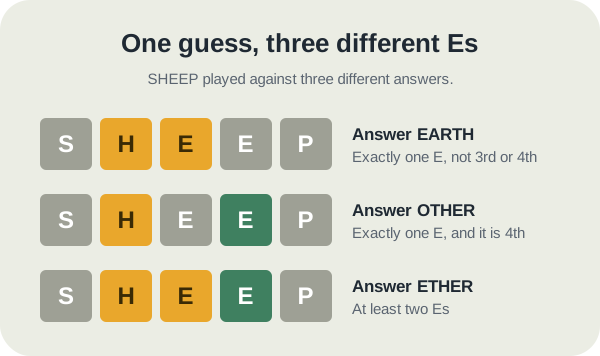
Take SHEEP as the guess, with its Es in the third and fourth places, and score it against three different answers.
Against EARTH it comes back grey S, gold H, gold E, grey E, grey P. One E is coloured and one is grey, so the answer has exactly one E. It is not third, because that tile would have been green, and it is not fourth for the same reason.
Against OTHER the third-place E is grey and the fourth is green. Again one coloured copy and one grey, so exactly one E, and the green tells you where it is. The grey third tile is not a contradiction. It is the game saying there is no second E to find.
Against ETHER both Es are coloured, one gold and one green. With no grey copy there is no ceiling, so the answer has at least two Es and might have more. The general rule is short: the coloured copies give you a minimum, and a grey copy of the same letter turns that minimum into an exact count.
The keyboard cannot show you this
The on-screen keyboard colours each key with the best result that letter has had in any guess so far: green beats gold, and gold beats grey. After SHEEP against EARTH, the E key is gold, which is true and incomplete. The keyboard has no way to say one E, not two.
That is where the common mistake comes from. Players who steer by the keyboard see a gold E and go on to try words with two Es in them, because nothing on the keyboard rules them out. The count only lives in the row itself. When a letter repeats in your guess, read that row tile by tile before you look down.
A worked board
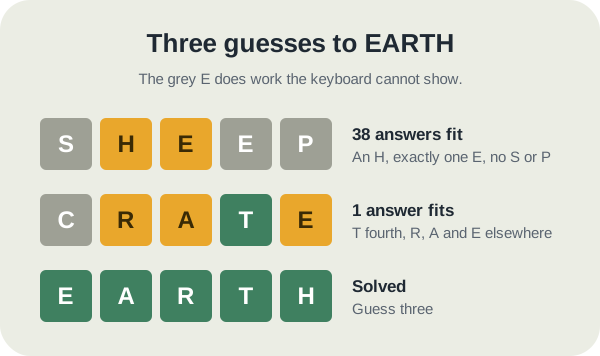
Here is SHEEP as an opener against EARTH, played through to the end. After the first row, the answer has an H somewhere other than second place, exactly one E somewhere other than third or fourth, and no S or P. That leaves 38 of the game's 2,315 answers.
Read the grey E only as not here, and ignore the count it gives you, and 41 words appear to fit. The three extra words all carry two Es. None of them can be the answer, and each one is a guess you could have spent for nothing.
CRATE comes next: grey C, gold R, gold A, green T in fourth place, gold E. Of the 38 words still standing, exactly one gives that pattern, so the third guess is EARTH and the board is solved. The second guess was fortunate here. Scored against every one of the 38, CRATE never leaves more than four, which is what makes it a sound choice even when it does not land this cleanly.
Should you guess repeats on purpose?
Usually not as an opener. A repeated letter spends a square on a question you may not need answered, and five different letters test more of the alphabet. SHEEP is used above because it shows the rule clearly, not because it is a strong first word.
Later in a board it is different. If you already know a letter is in the answer and the remaining words split on whether it appears once or twice, a guess with two copies settles that in one row. Either both come back coloured and you have a floor of two, or one comes back grey and you have an exact count of one.
Either way, the habit is the same. A grey tile on a letter you have also seen in colour is never a mistake by the game. It is the count, and it is worth reading.
Put it into practice
Try an Easy Five Letters Library puzzle and look for one deduction from this guide.
Play a Five Letters boardSign in or create an account to save your progress.