Hubbard

What you are actually allowed to do
You tap a source tube, then a destination. The balls come off the top of the source, and only balls of one colour move: the top ball and any others of the same colour directly underneath it. They land on the destination, which must either be empty or already have that same colour on top. The destination has to have room. The board is finished when every tube is either empty or holds four of one colour.
Read a tube from the bottom up. The ball at the bottom went in first and comes out last, so a colour buried at the bottom of a full tube cannot go anywhere until the three above it have left.
That gives you two limits at once. A tube can only receive a colour that matches its top ball, and it can only give you its top ball. Almost every board you get stuck on is stuck because those two limits met.
One empty tube, and that is the whole game
Every Colour Pour board is built the same way: as many full tubes as there are colours, plus exactly one empty one. Three colours means three full tubes and one spare. Five colours means five and one spare.
The spare is the only tube that will take any colour, so it is the only reason the first move exists at all. Every other tube starts full.
Here is where people go wrong. They treat that tube as somewhere to put a ball that is in the way. It is not storage. The moment a ball lands in it, it stops accepting every colour and starts accepting one, and you have spent the only open space on the board buying yourself whatever that one colour can do next.
Three opening moves, and one of them ends the board
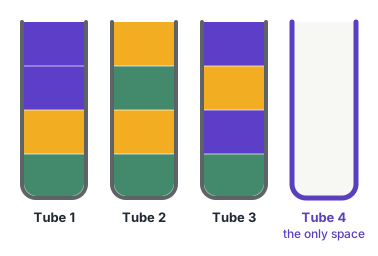
On this board there are exactly three legal first moves, because tubes 1, 2 and 3 are all full and can only pour into tube 4.
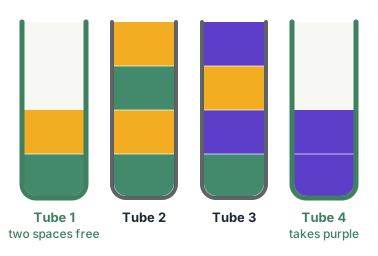
Pour the two purple balls off the top of tube 1 and the board stays solvable. Pour the single purple ball off the top of tube 3 and the board stays solvable. Both lines finish in ten moves in total, which is as good as this board can be played.
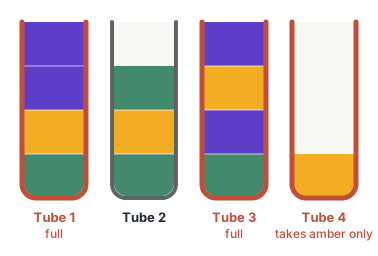
Pour the single amber ball off the top of tube 2 and the board is dead. Not harder, not longer. Dead. There is no legal move at all after it, and a search over every reachable position confirms it: nothing you could do next would have saved it.
Why that one and not the other two
Work out what the spare tube can receive after the pour, and then check whether anything on the board can supply it.
Pour amber into tube 4 and it will only take amber from then on. The amber you would need next is the one now sitting under a green in tube 2, and it cannot come out until that green moves. The green has nowhere to go, because tubes 1 and 3 are still full and tube 4 is holding amber. So the board has one colour it will accept and no way to reach it.
Pour purple into tube 4 instead and the picture is different, because purple is also the top ball of another tube. Tube 1 shows two purple, tube 3 shows one, and either can feed the other. That is the test, and it costs you a few seconds: after this pour, is the colour now on top of the spare tube also on top of somewhere else, or does the pour open a gap that lets something else move?
Pouring tube 1's two purple balls does both. The spare tube takes purple, tube 3's purple can follow it, and tube 1 comes down to two balls with two spaces free, which is the first real room anyone has had on this board.
The mistake, in one line
The mistake is choosing the opening pour by what it clears rather than by what it opens.
Pouring the amber off tube 2 is tempting for a reason that feels sensible: it uncovers a green, and greens are what tube 2 needs. It is the move that looks like progress. The trouble is that it pays for that with the only free space on the board, and buys a colour nothing can supply.
So before the first pour, and before any pour into a tube that is empty, ask what the tube will accept afterwards and where that colour is. If the answer is buried under something that cannot move, choose a different ball. On a board with one spare tube there is rarely a second chance, and unlike a timed game there is no clock stopping you from taking the extra look.
- Count the spaces, not the balls. One empty tube is one chance to be wrong.
- Before pouring into an empty tube, name the colour it will then accept and point at where the next one of that colour is coming from.
- A pour that empties two balls at once is usually better than one that empties one, because it leaves room in the tube you poured from as well.
- If every tube is full except the spare, your only legal moves are into the spare. That is the moment to think, not to tap.
Where to play it
Colour Pour is in the Library and For You, and it turns up as a Just for fun daily. It is not one of the ten competitive league games, so nothing here affects your standings: it is there to be played when you want a board rather than a result.
Easier boards use three colours and four tubes, as this one does. Harder ones go to four and then five colours, which adds tubes but never adds a second spare, so the same habit carries the whole way up.
Start with a three colour board and play the opening slowly. Name the colour your spare tube will accept before you tap, every time, until you stop needing to.
Put it into practice
Try an Easy Colour Pour Library puzzle and look for one deduction from this guide.
Play a Colour Pour boardSign in or create an account to save your progress.