Hubbard

What holds a ball up
The board has some fixed black cells, and the rest is divided into rooms drawn with a bold outline. Each room takes exactly one balloon and exactly one iron ball, and every other cell in it stays empty.
A balloon has to be held from above. That means it sits in the top row, or directly below a black cell, or directly below another balloon. An iron ball has to be held from below: the bottom row, or directly above a black cell, or directly above another iron ball.
Read that carefully and notice what it does not say. It says nothing about rooms. A balloon resting on top of another balloon does not care which room the lower one belongs to, and neither does an iron ball sitting on another iron ball. Support runs straight down the columns of the board and ignores the outlines completely. The outlines only control the counting.
A room cannot hold itself up
Now take one room and one of its cells, and ask whether that cell could be the room's iron ball. Look at the cell directly below it. If that cell belongs to the same room, the answer is no, and you can say so without knowing anything else about the board.
The reasoning is short. An iron ball needs the bottom row, a black cell, or another iron ball beneath it. The cell below is neither the edge of the board nor a black cell, because it is an ordinary cell of your room. So it would have to hold an iron ball. But it is in the same room as the ball you are placing, and a room holds one iron ball, which you have just spent. All three ways of being supported fail at once.
The balloon version is the mirror image. If the cell directly above belongs to the same room, that cell cannot be the room's balloon.
What makes this worth having is that it costs nothing to apply. You do not need a single placed ball, or a black cell anywhere nearby, or any reasoning about other rooms. You need the outlines, which are printed on the board from the start.
An original board
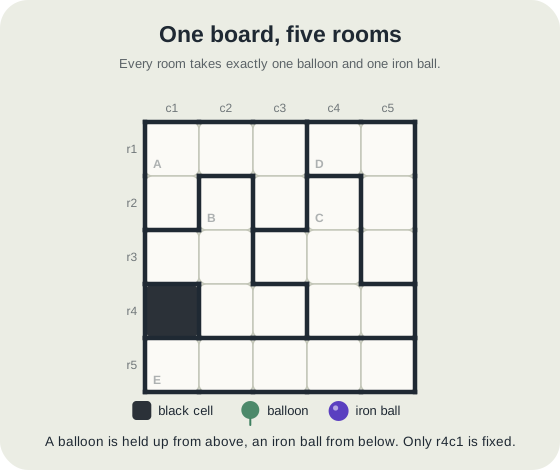
Here is a five by five board built for this article. One black cell sits at r4c1, and the other twenty-four cells make five rooms, labelled A to E.
Room A takes r1c1, r1c2, r1c3, r2c1 and r2c3. Room B takes r2c2, r3c1, r3c2, r4c2 and r4c3. Room C takes r2c4, r3c3, r3c4, r4c4 and r4c5. Room D takes r1c4, r1c5, r2c5 and r3c5. Room E is the whole bottom row.
The board has exactly one solution. That was confirmed twice: the game's own solver reports a single answer, and a separate enumeration written independently walked all 1,920,000 ways of putting one balloon and one iron ball in each of the five rooms and found the same single answer.
Eight cells gone in one pass
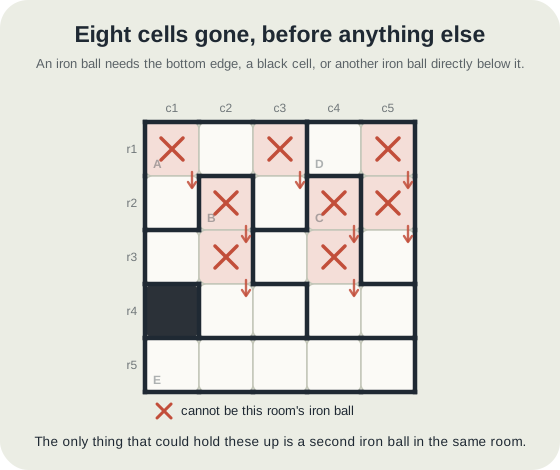
Walk the board once and mark every cell that has another cell of its own room directly beneath it. There are eight: r1c1, r1c3, r1c5, r2c2, r2c4, r2c5, r3c2 and r3c4. None of them can be its room's iron ball.
That is a third of the playable board removed for one of the two pieces, and every room except E has lost at least one option. Room D is down to two candidates for its iron ball, r1c4 and r3c5. Room C is down to three.
Note where the rule goes quiet. Nothing in the bottom row is ever ruled out, because those cells sit on the edge of the board. Nothing directly above the black cell at r4c1 is ruled out either, which is why r3c1 survives while r3c2 next to it does not. Black cells are support, and they belong to no room, so the counting argument never reaches them.
What r1c4 cannot do
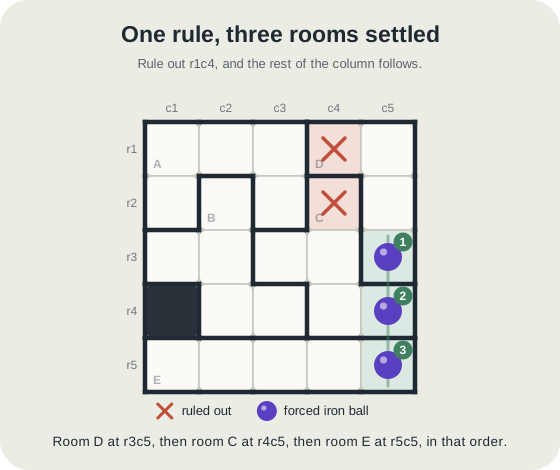
Room D now has two places for its iron ball, so try to separate them. Suppose it goes at r1c4. That cell is in the top row, not the bottom, and the cell below it is r2c4, which is an ordinary cell of room C. So r2c4 would have to hold an iron ball, and it would have to be room C's.
It cannot. Apply the same rule again: below r2c4 sits r3c4, also room C. r2c4 is one of the eight cells already crossed out. Room C has no way of putting an iron ball there, so nothing can hold up an iron ball at r1c4, and room D's iron ball goes to r3c5.
The rest follows on its own. r3c5 is not the bottom row and r4c5 is not black, so r4c5 must hold an iron ball, and r4c5 belongs to room C. That settles room C. Then r4c5 is not the bottom row either, so r5c5 must hold an iron ball, and r5c5 belongs to room E. That settles room E, and because r5c5 is in the bottom row, the chain stops there.
Three rooms placed, in order, from one rule used twice and then followed downhill. All three placements match the board's unique solution.
The mistake worth avoiding
The slip that costs most people this board is in the middle step. Having cut room D to r1c4 and r3c5, it is tempting to look at r1c4, see an ordinary cell beneath it belonging to a different room, and call it supportable. A neighbouring room is allowed to hold your ball up, after all, and that is a real and useful fact about Float & Fall.
It is only useful when the neighbour can actually do it. Borrowed support is a claim about the other room's placement, and that room has its own geometry. Room C cannot put its iron ball at r2c4 for exactly the reason room D cannot leave one hanging there. Whenever you lean on a neighbour, check that the cell you are leaning on is still a live option for whoever owns it.
There is a second, gentler mistake going the other way: assuming each room needs an anchor of its own, and hunting for the rooms that touch an edge or a black cell. Rooms A and B on this board hold the answer to that. Room B's balloon ends up at r2c2, held up by room A's balloon at r1c2, which is in the top row. Room B never touches the top row at all. Stacks cross room lines freely and can run several cells deep.
Where Float & Fall sits on the site
Float & Fall is a timed game in Practice and Just for fun. It does not appear among the competitive dailies and awards no league points, so it is a good place to try an idea out without a ranked clock running on your standings.
You will find it in the Library, where you can filter to the game and work through boards at your own pace. It is also in the For You catalogue by default, so it can come up there unless you have excluded it in your feed preferences, and a dated Just for fun board is published for it each day alongside the rest of the catalogue.
Try the rule as your opening move on the next board you start. Mark every cell with its own room directly below it, then do the same for the cells with their own room directly above. On most boards you will have removed a large part of the grid before you have made a decision about anything.
Put it into practice
Try an Easy Float & Fall Library puzzle and look for one deduction from this guide.
Play a Float & Fall boardSign in or create an account to save your progress.